Most articles about positive EV betting will tell you to subscribe to a $79/month tool that scans 30 sportsbooks and pings you when there's a +EV opportunity. That works. But it also keeps you from actually understanding what you're doing.
Quick answer
Positive EV betting means only placing bets whose odds exceed the true probability. EV = (p × potential profit) − ((1 − p) × stake). Finding +EV spots requires beating the closing line or spotting soft lines across books. It is the only mathematically sound path to long-term betting profit.
This guide does the opposite. You'll learn what positive EV betting actually is, how to find +EV bets manually using free public data, what kind of returns are realistic, and the four reasons most +EV bettors quietly lose money even when their math is right.
By the end you'll know whether positive EV betting is something you should pursue, and if so, whether you actually need a paid tool or can get started without one.
What is positive EV betting?
A positive EV bet (also written +EV, short for positive expected value) is a bet where the math says you'll make money on average over a large number of identical bets, even if you lose any individual one.
Expected value is the long-term average outcome of a bet. If you flip a fair coin and someone offers you $1.10 for heads, $1.00 risk on tails, your expected value per flip is +$0.05. You'll lose roughly half the time. But if you take that bet 10,000 times, you'll end up roughly $500 richer. That's positive EV.
In sports betting, a +EV bet is one where the price you're getting from a sportsbook is better than the true probability of the outcome happening. If a coin flip is 50/50 and a book offers you +110 (decimal 2.10) on heads, that's +EV. Your true probability is 50% but the book is paying you as if it was 47.6%.
The hard part — and this is where 99% of bettors mess up — is figuring out the true probability of a sports outcome. Heads/tails is easy. Will the Chiefs cover -3.5 against the Bills is not.
The expected value formula
The basic EV formula in sports betting is:
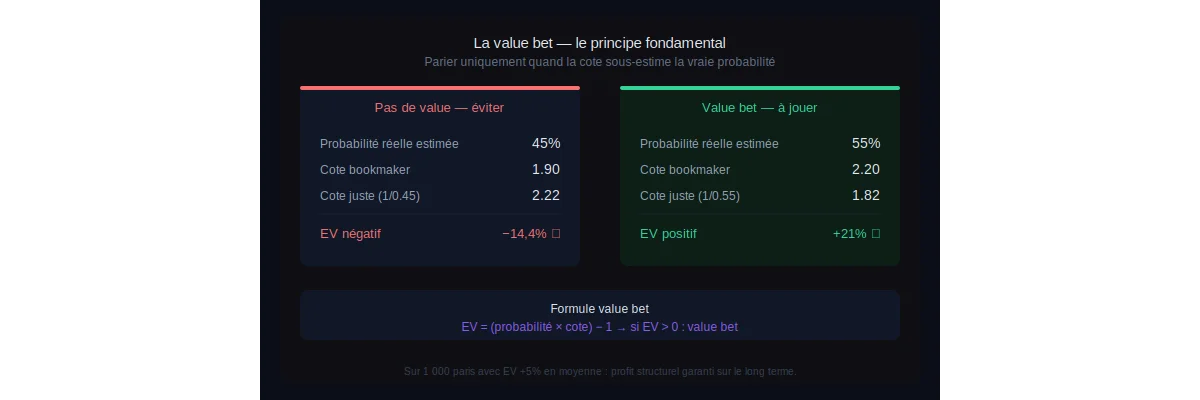
EV = (Probability of winning × Profit if you win) − (Probability of losing × Amount risked)
Or in simpler terms when you express odds as decimal:
EV per $1 bet = (True probability × Decimal odds) − 1
A positive result means +EV. A negative result means −EV. Zero is a break-even bet.
Quick example. The Eagles are +145 (decimal 2.45) on DraftKings to beat the Cowboys. You believe the true probability of an Eagles win is 45%.
EV = (0.45 × 2.45) − 1
EV = 1.1025 − 1
EV = +0.1025
That's a +10.25% expected return on every dollar risked. Bet $100 a thousand times in identical conditions and you walk away with about $10,250 in profit on average.
The catch: that 45% probability needs to be right.
The hidden challenge: how do you know the "true" probability?
This is the question every +EV bettor has to answer, and it's where the entire approach lives or dies.
You can't just guess. "I think the Eagles win 45% of the time" with no logic behind it is not a probability estimate, it's a feeling. Three legitimate ways exist to estimate true probabilities:
1. Build your own model. Pull historical data, train a regression or a basic machine learning model, output win probabilities. This is what most quantitative bettors do. It takes weeks of work and constant tuning to be useful, and 99% of bettors aren't going to do it.
2. Use the sharp book line as a proxy. This is the easiest and most reliable shortcut. Pinnacle and Circa Sports are considered "sharp" sportsbooks — meaning they take big bets from professional bettors and adjust their lines based on smart money. Their lines are widely treated as the closest thing to a "true" market price in sports betting. If Pinnacle has the Eagles at +130 (implied 43.5%) and DraftKings has them at +145 (implied 40.8%), DraftKings is offering a +EV price relative to the sharp market.
3. Use a paid +EV tool. Tools like OddsJam, Unabated, OddsShopper, and Outlier do exactly the comparison above, but across 20+ sportsbooks in real time. They surface the +EV opportunities for you. They cost $50-$100/month.
The sharp-book method (#2) is what we'll focus on. It's free, it teaches you what's actually happening, and it's how the industry calculates EV under the hood.
How to find +EV bets manually with the Pinnacle method
Here's the workflow, step by step.
Step 1: Pull a Pinnacle (or Circa) line for a market you care about.
Pinnacle posts lines publicly. For an NFL game, you might see:
- Eagles +130 / Cowboys -150 (moneyline)
Step 2: Convert to implied probability and remove the vig.
Pinnacle's vig is much smaller than US books (typically 2-3% vs 4-8%). To remove it, do this:
- Eagles +130 → implied 43.48%
- Cowboys -150 → implied 60.00%
- Total = 103.48% (the 3.48% over 100% is the vig)
- Vig-free Eagles probability = 43.48 / 103.48 = 42.0%
- Vig-free Cowboys probability = 60.00 / 103.48 = 58.0%
That 42% is your best estimate of the "true" probability of the Eagles winning.
Step 3: Compare to other US sportsbooks.
Now check DraftKings, FanDuel, BetMGM, Caesars, ESPN BET. Look for any book offering a price better than the vig-free Pinnacle probability of 42%.
- 42% true → fair odds = +138 (decimal 2.38)
- DraftKings posts Eagles +145 (decimal 2.45) → +EV
- FanDuel posts Eagles +135 → −EV (worse than fair)
- BetMGM posts Eagles +150 → +EV (even better)
Step 4: Calculate the EV%.
For BetMGM at +150:
EV = (0.42 × 2.50) − 1 = +0.05 = +5% EV
Bet there. The math says you're +5% on this wager.
That's the whole methodology. Pull the sharp line, convert to vig-free probability, find a US book paying more, calculate the edge.
What kind of returns can you actually expect?
This is the part most +EV marketing skips. Realistic numbers:
- Most genuine +EV opportunities are in the +1% to +3% range, not +10%
- Strong +EV opportunities (+5% or more) exist but get steamed off the line within minutes
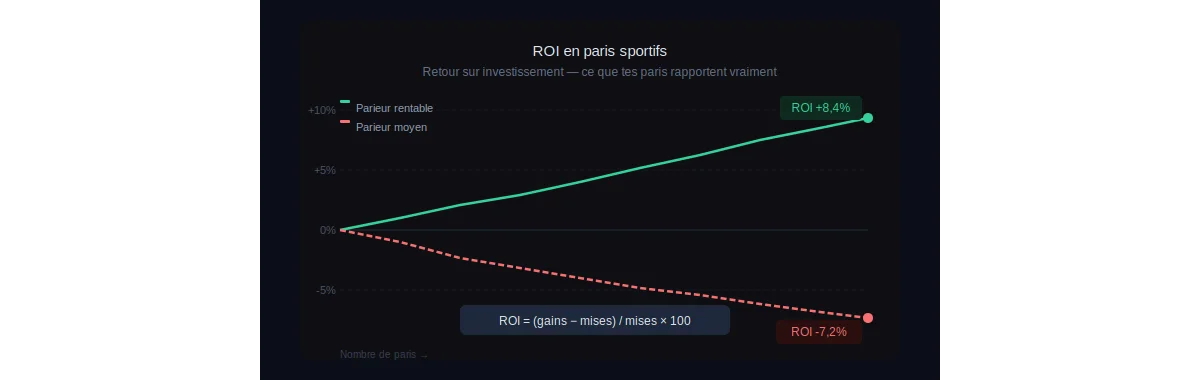
- A disciplined +EV bettor running 200-500 bets per month can target a long-term ROI of 3-7%
- Variance is brutal. Expect 200+ bet losing streaks and 30%+ bankroll drawdowns even when your edge is real
If you bet $100 average per wager at +5% ROI on 300 bets per month, that's $1,500 in expected monthly profit — on average, with months where you'll lose $3,000 and months where you'll make $4,500. The variance dwarfs the edge in any short window.
This is why most +EV bettors quit. They expected steady gains. They got rollercoasters with a small upward slope.
Is positive EV betting profitable in the long run?
Yes, if three things are true:
- Your probability estimates are actually accurate (you're using a real sharp line, not gut feel)
- You can place enough bets to overcome variance (typically 1,000+ bets minimum)
- You aren't getting limited by the sportsbooks before you make meaningful money
That third point is where most aspiring +EV bettors end up. Sportsbooks aren't charities. If they detect that you're consistently betting +EV markets, they will reduce your max bet, restrict you from promos, or close your account entirely. This usually happens to bettors making sharp lines work for them within weeks.
The ones who survive are the ones who:
- Bet relatively normal amounts and don't hammer obvious +EV bets
- Mix in some recreational-looking bets (parlays, longshot props) to stay under the radar
- Spread action across many sportsbook accounts
This is unglamorous. But it's the actual game.
The 4 reasons most +EV bettors fail
1. They use bad probability estimates.
Treating a non-sharp book line as "true probability" or making up a number based on feel. Garbage in, garbage out. Without a real sharp benchmark, the math is meaningless.
2. They quit during variance.
A +5% edge doesn't feel like an edge after losing 18 of your last 25 bets. That happens. If you can't stomach a 30% drawdown without changing your strategy, +EV isn't for you.
3. They get limited and don't adapt.
First sign of getting limited is your max bet dropping from $500 to $50 overnight. At that point you have two options: spread to more books or accept smaller volume. Most people just keep betting at the limited book and grind nothing.
4. They don't track properly.
After 200 bets, you should know your actual ROI vs your expected ROI. If your expected ROI is +5% and you're at -2%, your probability estimates are off and you need to investigate why. Without tracking, you're just guessing whether you have an edge.
This is the same lesson from bankroll management: the math only works if you're measuring whether the math is actually working.
Positive EV betting vs arbitrage betting
These often get confused. They're different.
Arbitrage locks in a guaranteed profit by betting both sides of an event at different sportsbooks where the prices contradict each other. Example: Eagles +130 at DraftKings, Cowboys +110 at FanDuel. If you size correctly, you profit no matter who wins.
Positive EV doesn't guarantee any individual bet. You're betting the side where the math says you have an edge, but you'll lose plenty of individual bets. Profit only emerges over thousands of bets through the law of large numbers.
Arbitrage has lower variance but smaller margins (usually 0.5-2%) and gets you limited even faster than +EV. Positive EV has higher variance but better long-term ROI and is somewhat more sustainable. Most professional bettors do both.
Do you actually need a +EV betting tool?
Honest answer: it depends on how serious you are.
You probably don't need a paid tool if:
- You're learning the concept and want to understand the math
- You bet recreationally (5-20 bets per week)
- You stick to one or two sports and a few markets you know deep
- You're willing to manually compare lines across 3-5 sportsbooks
You probably do need one if:
- You want to make real money (200+ bets per month across many books)
- You can't manually scan 30 sportsbooks every few hours
- You're focused on player props (where the +EV opportunities are biggest and disappear fastest)
- The cost is below your expected monthly profit
Free options that get you 80% of the way: scrape Pinnacle's lines, set Google alerts for big games, use free odds aggregators like Vegas Insider or Odds Shark for line comparisons. None of this is as good as a real tool, but it's enough to learn the methodology and place a few +EV bets per week.
How to combine +EV betting with bankroll management
Finding +EV bets is half the job. Sizing them correctly is the other half. Bet too much on each +EV opportunity and a normal losing streak wipes you out before the math works.
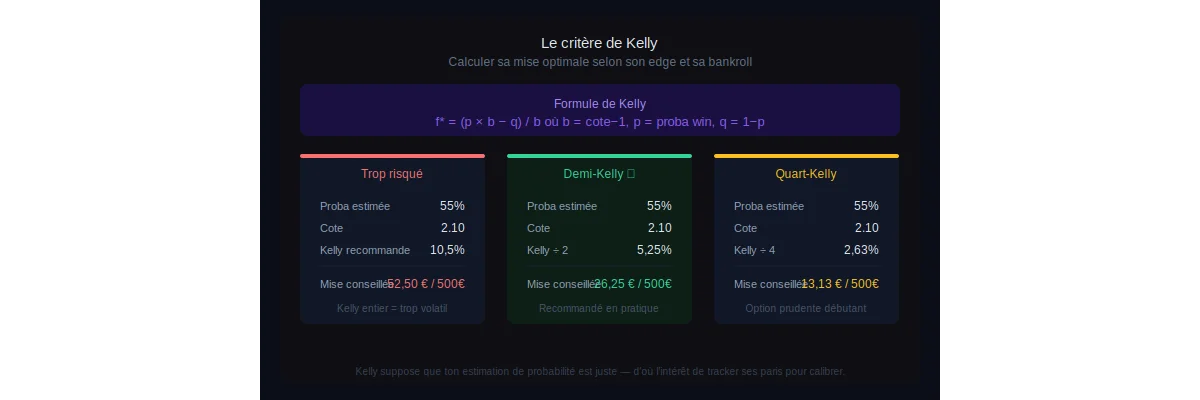
Most professional +EV bettors size each bet at 1-2% of bankroll, regardless of the EV%. A few use a fractional Kelly Criterion approach — typically quarter Kelly — which scales bet size with the edge. Both approaches survive the variance. Betting 5% or more per +EV play does not.
The discipline of sizing matters more than finding bets with +6% edge instead of +3%. A +3% bet sized correctly outperforms a +6% bet sized too large, every time, over the long run.
FAQ
What is positive EV betting in simple terms?
Positive EV betting means placing bets where the math says the price you're getting is better than the true probability of the outcome. It's a long-term strategy: you'll lose individual bets, but profit emerges across hundreds or thousands of bets if your edge is real.
Does positive EV betting actually work?
Yes, if your probability estimates are accurate. The math is sound — it's the same logic that runs hedge funds and casinos. The hard part is estimating true probabilities, sustaining through variance, and avoiding sportsbook limits.
Is positive EV betting profitable?
A disciplined +EV bettor can target 3-7% ROI long-term. That's $30-$70 profit per $1,000 wagered, on average. Big numbers come from high volume, not high edge per bet.
How do I find positive EV bets?
The free method: pull the line from a sharp sportsbook (Pinnacle or Circa), convert to vig-free probability, then check US books for prices that beat that fair probability. The paid method: use a +EV scanner like OddsJam or Unabated.
How much should I bet on a +EV opportunity?
Most professionals size each +EV bet at 1-2% of bankroll. Some use fractional Kelly (typically quarter or half Kelly) to scale bet size with the edge. Avoid betting more than 3% of bankroll on any single +EV play, regardless of how strong the edge looks.
Will sportsbooks ban me for positive EV betting?
Eventually, yes — most US sportsbooks limit or close accounts that consistently beat their lines. The countermeasures are spreading action across many books, mixing in recreational-looking bets, and not making it obvious you're a sharp.
Bottom line
Positive EV betting is the closest thing to a real "winning strategy" in sports betting. It's not a shortcut to riches and it doesn't feel like winning when you're in a 50-bet losing streak. But the math is real, and bettors who execute it with discipline can be long-term profitable.
The path:
- Learn the concept by manually comparing sharp lines (Pinnacle/Circa) to US sportsbook prices
- Place small +EV bets to get a feel for the variance
- Track every bet's expected ROI vs actual ROI to verify your edge is real
- Scale up cautiously, with 1-2% per-bet sizing
- Add a paid tool only when your volume justifies it and you've already proven the method works for you
MyBankroll gives you the tracking layer that makes +EV betting actually verifiable. Log every bet with the implied probability you got versus the closing line, see your expected ROI broken down by sport and bet type, and know within a few hundred bets whether your edge is real or you've been running hot. The math doesn't lie — but only if you're measuring it.