Most bettors get bet sizing wrong in one of two ways. They risk half their bankroll on a "lock" they're sure about, or they bet $20 on a play they should be hammering. There's no logic, just gut feeling.
Quick answer
The Kelly Criterion sizes your stake from your edge: Stake = Bankroll × (p × o − 1) ÷ (o − 1), where p is your estimated win probability and o the decimal odds. Most professionals bet half-Kelly or quarter-Kelly to reduce variance. If you have no genuine edge, Kelly's answer is zero — don't bet.
The Kelly Criterion gives you a math-backed answer to one question: how much should I actually risk on this bet? It was developed in 1956 by a Bell Labs researcher and is now used by hedge funds, professional poker players, and the sharpest sports bettors in the world.
In this guide you'll learn what the Kelly Criterion is, how to calculate it with American odds, why most professionals only use a fraction of it, and the mistakes that quietly wipe out bankrolls.
What is the Kelly Criterion?
The Kelly Criterion is a formula that tells you what percentage of your bankroll to bet when you have an edge. It was created by John Larry Kelly Jr., a researcher at Bell Labs, in a 1956 paper originally about telephone signal transmission. The math turned out to apply perfectly to any situation where you're investing under uncertainty with a known edge.
Today, Kelly is used by:
- Hedge funds sizing positions
- Professional poker players choosing how aggressive to play
- Quantitative traders managing portfolio risk
- Sharp sports bettors deciding stake sizes
The core idea is simple: if you bet too little when you have an edge, you grow your bankroll too slowly. If you bet too much, you risk going broke from variance even when you're right on average. Kelly finds the mathematically optimal point between those two extremes.
The Kelly Criterion formula
The standard Kelly formula in decimal odds looks like this:
Kelly % = (Decimal Odds × Estimated Probability − 1) / (Decimal Odds − 1)
The result is the percentage of your bankroll you should bet.
For American odds, you have two options. The cleanest is to convert American odds to decimal odds first:
- Positive odds (e.g. +150): Decimal = (American / 100) + 1 → +150 becomes 2.50
- Negative odds (e.g. −150): Decimal = (100 / |American|) + 1 → −150 becomes 1.667
Then apply the same Kelly formula. Let's walk through real examples.
Example 1: NFL game with American odds
It's late November. The Chiefs are hosting the Bills. DraftKings posts:
- Chiefs −150 (decimal: 1.667)
- Bills +130 (decimal: 2.30)
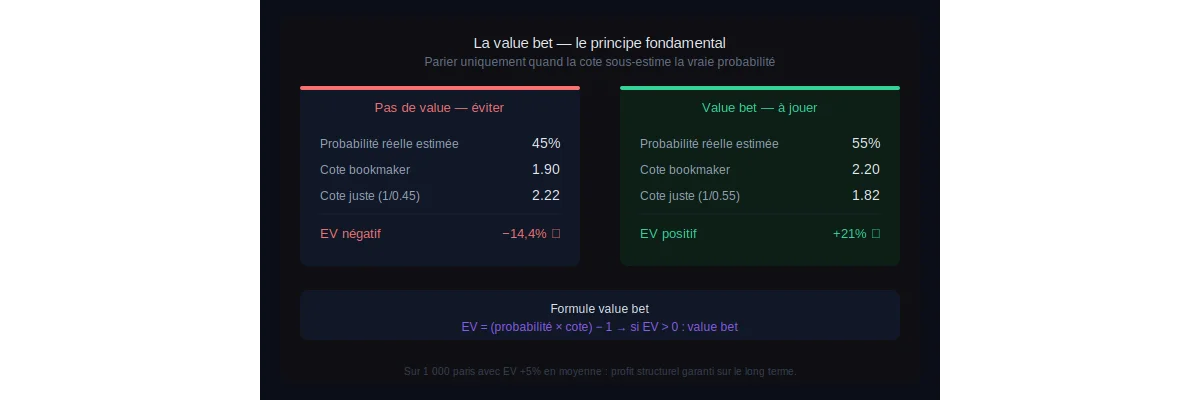
You've watched both teams all season, you're tracking injury reports, and you genuinely believe Buffalo wins this game 50% of the time. The market is pricing them at roughly 43% (implied from +130).
That gap is your edge. Let's run Kelly on the Bills:
Kelly % = (2.30 × 0.50 − 1) / (2.30 − 1)
Kelly % = (1.15 − 1) / 1.30
Kelly % = 0.15 / 1.30
Kelly % = 11.5%
Full Kelly tells you to bet 11.5% of your bankroll on the Bills moneyline. On a $2,000 bankroll, that's $230 on a single NFL game.
Hold that number. We'll come back to why you almost certainly should not bet that much, even when the math says so.
Example 2: NBA total where Kelly says "don't bet"
Lakers vs Celtics. FanDuel posts:
- Over 228.5 at −110 (decimal: 1.91)
You've looked at pace numbers and recent games, and you estimate the over hits about 50% of the time. Let's run Kelly:
Kelly % = (1.91 × 0.50 − 1) / (1.91 − 1)
Kelly % = (0.955 − 1) / 0.91
Kelly % = −0.045 / 0.91
Kelly % = −4.9%
Negative result. Kelly is telling you not to bet. By your own probability estimate, the line doesn't offer enough payout to justify the risk. The juice (the −110 vig) is eating your edge.
This is one of the most useful properties of Kelly: it filters out bad bets automatically. If the formula returns zero or negative, the price isn't worth it for your estimate. Pass.
The hidden problem: you have to estimate the probability
Here's where the formula gets dangerous, and where most bettors blow up.
The decimal odds are public. You can pull them from any sportsbook in two seconds. But the true probability that the Bills beat the Chiefs? Nobody knows that with certainty. You estimate it. And if your estimate is wrong, Kelly gives you the wrong bet size.
Worse: Kelly amplifies your estimation errors.
If you think the Bills win 50% but the true probability is 43% (what the line implies), you don't have an edge at all. You just think you do. Kelly will tell you to bet 11.5% of your bankroll on a coin flip you're losing on average. Do that for a season and you're broke.
This is the core reason most people who hear about Kelly and try it lose money fast. The formula is mathematically perfect if your probability inputs are accurate. They almost never are.
Fractional Kelly: what the pros actually use
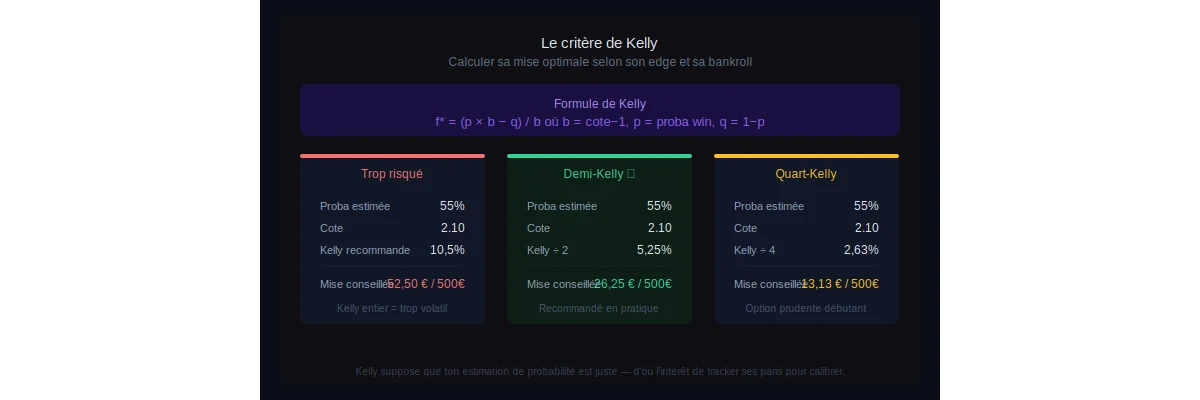
Professional bettors know they can't estimate probabilities with surgical precision. So they don't use full Kelly. They use a fraction of it, typically:
- Half Kelly (50%) — the most common professional standard
- Quarter Kelly (25%) — for newer bettors or markets where estimation is harder
Going back to our Bills example, full Kelly said 11.5%. In half Kelly, you bet 5.75% of your bankroll. In quarter Kelly, 2.9%.
Why give up the upside? Because fractional Kelly protects you from your own overconfidence. If your estimates are slightly off, half Kelly cushions the damage. You grow your bankroll more slowly when you're right, but you avoid catastrophic drawdowns when you're wrong.
The math backs this up. Half Kelly captures roughly 75% of full Kelly's long-term growth rate, but with about a quarter of the bankroll volatility. That's a trade most professionals make every time.
Kelly Criterion vs the unit system (flat betting)
Most US bettors use the unit system: pick a unit size (usually 1-2% of bankroll) and bet the same amount on every play, with maybe a "2-unit" or "3-unit" bump for high-confidence plays. It's simple, disciplined, and it works.
Kelly is different. It scales your bet size based on the edge you think you have. Big edge = bigger bet. Small edge = small bet. No edge = no bet.
In theory, Kelly is mathematically superior to flat betting because it maximizes long-term bankroll growth. In practice, Kelly is more dangerous because it depends entirely on the quality of your probability estimates. If you estimate badly, you lose money faster than you would with flat betting.
For most bettors, the honest truth is this:
- If you can't reliably estimate probabilities (no model, no tracking history, no proven edge), use the unit system. 1% per bet, 2% on your strongest convictions. Done.
- If you have a tracked, proven edge over hundreds of bets with calibrated probability estimates, fractional Kelly (quarter or half) is a powerful tool.
There's no shame in flat betting. Most profitable recreational bettors use it. Kelly is for people who've already proven they can pick winners and want to optimize stake sizing.
Mistakes that wipe out Kelly bettors
Never use full Kelly. When the formula tells you to bet 15% of your bankroll on a single NFL game, don't. A normal losing streak (and there will be one) will cut your bankroll in half. Always use a fraction.
Never apply Kelly to parlays. Parlay probabilities multiply, and so do your estimation errors. A 3-leg parlay where you're slightly off on each leg compounds into a wildly wrong Kelly recommendation. Kelly is for single bets only.
Don't confuse conviction with probability. "I have a strong feeling the Chiefs cover" is not 70%. To use Kelly correctly, you need to be able to say "the Chiefs cover this number in 58% of comparable situations" with actual reasoning behind it (matchup data, situational stats, line movement). If your only input is gut feel, stick with the unit system.
Don't anchor your probability to the line. This is subtle but critical. If you're estimating "70% to win" and then look at the sportsbook line and adjust to "65% because the line is shorter than I expected," you're letting the market's opinion bleed into yours. Estimate first, look at the line second. Otherwise you're just betting the market price with extra steps.
Don't re-bet after a loss. Kelly assumes you bet the formula's output and walk away. Some bettors lose, then "increase Kelly" to chase. That's not Kelly. That's tilt.
Why tracking matters more than the formula
Kelly only works if your probability estimates are accurate. The only way to know if your estimates are accurate is to track them.
After 200-300 bets, you should be able to look back and say: of all the bets where I estimated 60% to win, what percentage actually won? If you estimated 60% and they hit 55% of the time, you're slightly overconfident. Adjust down. If they hit 60% on the nose, your model is calibrated and you can trust Kelly more aggressively.
This is what separates sharps from squares. Sharps don't just track wins and losses. They track:
- Their estimated probability for each bet
- The line they got vs the closing line (CLV)
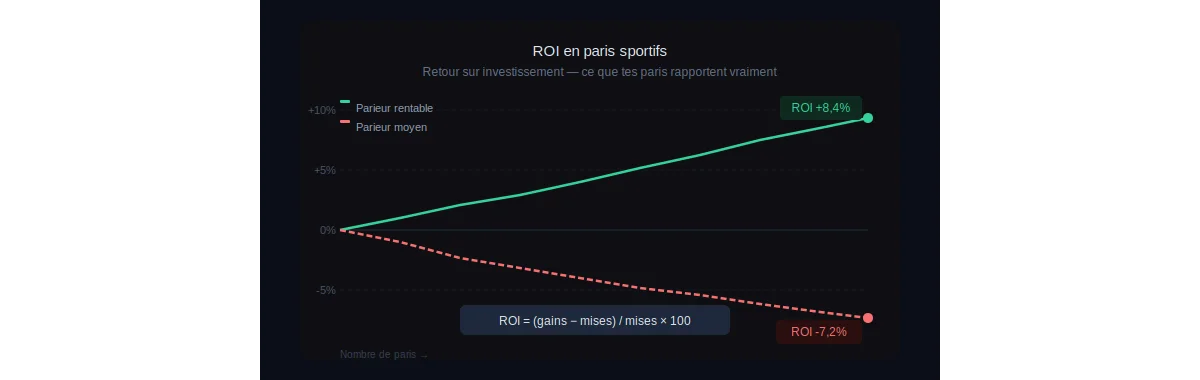
- ROI by bet type, sport, and market
- Calibration over rolling windows
Without that data, you're using Kelly on faith, which is the worst way to use any betting tool.
Bottom line
The Kelly Criterion is a powerful framework for sizing bets when you have an edge. It tells you exactly how much to risk based on your estimated probability and the offered payout. Done right, it maximizes long-term bankroll growth.
Done wrong, it accelerates losses faster than any other staking method. The formula is only as good as your probability inputs, and most bettors overestimate their edge.
If you're serious about using Kelly:
- Start with quarter or half Kelly, not full
- Apply it only to single bets, never parlays
- Track every estimate against actual results to calibrate over time
- Drop back to flat betting if your tracked ROI doesn't show a real edge
MyBankroll is built for bettors who want this level of seriousness. Track every bet with your estimated probability, get automatic CLV calculation against closing lines, see your ROI broken down by sport, market, and bet type, and find out whether your edge is real or just variance. Whether you're running Kelly, half Kelly, or a clean unit system, the numbers tell you the truth.